Monday, 13 June 2011

Sea Watch Celebrates World Oceans Day

World Oceans Day 2011 occurred on Wednesday 8th June. In order to celebrate this International Day of Ocean Conservation, recommended in 1992 at the Earth Summit in Rio de Janeiro and recognised by the United Nations, we decided to host a day of ocean themed events. Since children were our target audience, we held the event on Saturday 4th June, the last weekend of their school holiday.

Our day began at 11am when we set up our stand on New Quay pier and our beach spot. Public awareness and education was the focus of our place on the pier with posters about our research and adopt a dolphin scheme.


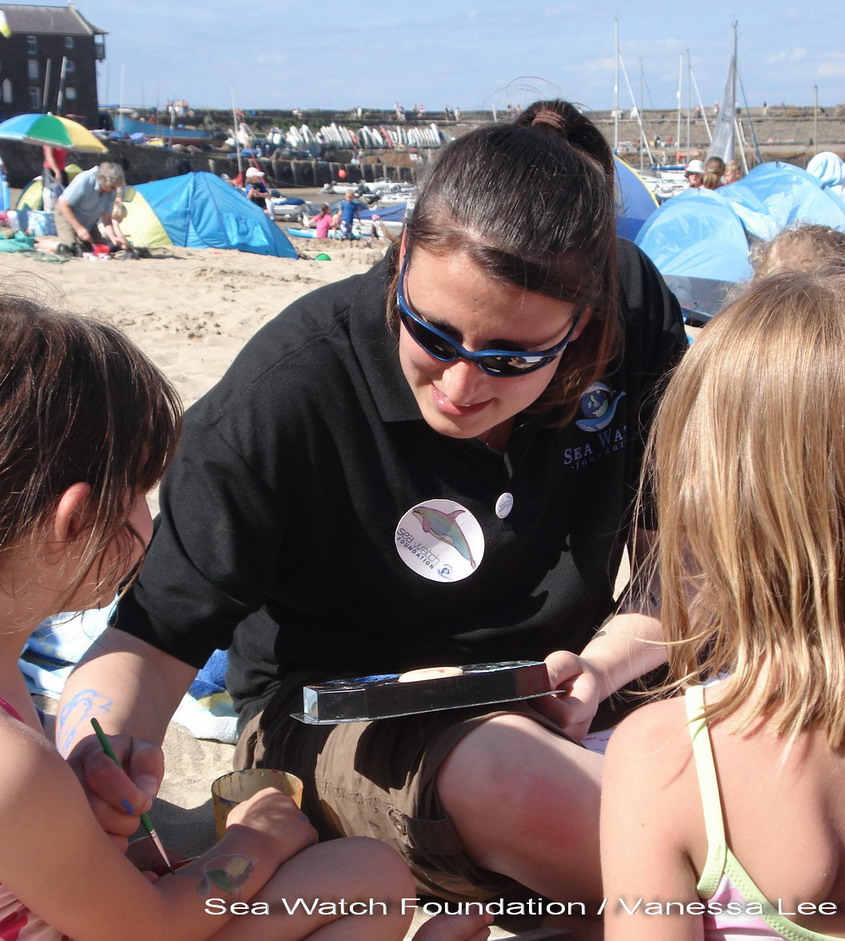
Meanwhile, on the beach we carried out our cetacean based activities. These included badge making, sand sculpturing, bracelet making and face painting. After painting each others faces we each made a badge in an attempt to advertise our activities and draw in interested audiences. Unfortunately, the glorious weather acted as a hindrance as children and adults were more interested in swimming in the Sea than getting their face painted. In an attempt to attract some attention, Rachel and Deborah began making a whale sand sculpture which did attract the help of one little girl.


After lunch, we were more successful with several children interested in either building sand dolphins or making badges. As the afternoon drew to a close, we found ourselves inundated with children either wishing to make friendship bracelets or have their face painted. As Deborah demonstrated how to make the bracelets, Rachel found herself surrounded by children either wanting their face painted or queuing up to paint her arms and face!


After calling in some re-enforcements we successfully managed to paint all the children’s faces whilst describing the biology and ecology of the animals being drawn. Despite the slow start to the day, the end was highly successful and the children involved seemed to have thoroughly enjoyed their time with us.

Monday, 6 June 2011

First Dedicated Survey of the Season!


We’d been waiting for this chance for weeks. Finally, after a long spell of rough weather, the wind and seas calmed and the date was set for the first dedicated boat survey of the season.

On Thursday, the whole Sea Watch Cymru team was up a little after the dawn chorus and long after the dolphins, but before most of New Quay’s residents. Conditions were perfect – the skies were lightening to a deep blue and the sea was like a mirror, a true sea state zero (something that we’d been told about, but had never got to see). A few bottlenose dolphins had already been spotted not far from New Quay pier and having gathered together all the equipment – life jackets, binoculars, cameras, the Photo Identification flag, a GPS receiver, clipboards, sightings and effort forms, many pencils and erasers, layers of clothing and lots of water, food and sun-tan cream – we set out on the Dunbar Castle II just before 8am.

But what is all this effort for?

A dedicated boat survey has many purposes. One is to gather information on sea mammal numbers, locations and behaviours. A further, important goal is to get photographs of as many of the dolphins as possible, specifically the fins, to build upon the identification catalogue Sea Watch already has. Identifying the animals individually is crucial in order to develop a clear picture of each dolphin’s life: where it usually lives, where it travels to, which other individuals it socialises with and if it has any calves. Each time a dolphin is identified, it makes this ‘life picture’ clearer. To read more about the process of identifying a dolphin through photographs, take a look at the blog entry for 25th May, 2011.

During the boat survey each team member regularly swapped roles – scanning from the roof, taking down ‘effort’ information (including the boat’s location, course and speed, the sea and weather conditions), noting down marine mammal sightings (including location, number and behaviour of the animals), taking photographs, counting and re-counting dolphin numbers (as dolphins can appear and disappear rapidly, counting how many dolphins there are in a group is often a challenge).

When any dolphins were sighted, the team went into identification, or ID, mode, which means putting up the Photo ID flag to show that the boat is on a dedicated survey and has permission to get close to the dolphins for a limited time to photograph them (normally, boats must follow the marine code for the Cardigan Bay Special Area of Conservation and not pursue dolphins in any way).

Over the six hours of heading down the coast to Cardigan Bay and back, we met at least 12 individual dolphins – although we haven’t processed all the photographs to confirm that yet. And we were lucky enough to get lots of close-up photos as the dolphins swam alongside the boat, dipped under the boat, leapt out of the sea and slapped the surface. One female, Top Notch, a Sea Watch adoptable dolphin, was easy to identify and was seen with her calf.

By 2 o’clock the skies were clouding over, the sea had lost its glassy texture and the Sea Watch team was exhilarated and exhausted. The first dedicated survey of the season was at an end.

(photos by Sea Watch Foundation/Elena Gladilina/Katrin Lohrengel/Gemma Veneruso)

Friday, 3 June 2011

One month with the Sea Watch Foundation!


One month of volunteering at the Sea Watch Foundation has already passed. The beginning of this season has already given us – the volunteers – some unforgettable experiences with many sightings and some impressive dolphin behaviour. The events ahead, such as the World Oceans Day, and the regular monitoring sessions, which will continue until early October, will surely bring more exciting surprises and special moments.

Daily land-watches and regular one or two-hour casual watch boat surveys (done when the weather conditions are favourable) have allowed us so far to spot many grey seals (Halichoerus grypus) and bottlenose dolphins (Tursiops truncatus) in Cardigan Bay, West Wales. Studies have shown that Cardigan Bay harbours semi-resident groups of bottlenose dolphins. While on duty, the close and clear photos of dolphins taken during a land-watch session or a boat survey, which provide a good lateral view of the dorsal fin showing its unique marks and nicks, are used for identification and the tracking of individuals.

It is truly impressive to experience relatively close contact with these beautiful marine mammals. The curious grey seals, for example, which usually stick the head out of the water just for a few seconds before continuing their slow and gentle swim, can get very close to the pier, the place from which all land-watches of marine wildlife in the area are carried out. Similarly, the bottlenose dolphins, which are usually seen in small groups performing long dives and sometimes showing the fluke while looking for fish in shallow waters, can also get very close to the pier. Furthermore, while on a boat survey, bottlenose dolphins can be seen swimming really fast alongside the boat and even performing some aerial behaviour. On one occasion, when I was doing a boat survey, I was lucky enough to witness a couple of bottlenose dolphins – a mother and its calf – swimming very fast and close together less than 50 metres away from the boat.

All this wonderful experience is particularly touching to me, a Brazilian biologist who had never had any experience in Marine Biology prior to arriving in Wales. Everything is new, interesting and exciting. The beautiful surrounding landscapes and the harmony of nature only make my volunteering at the Sea Watch Foundation even more special. I am looking forward to learning even more about marine wildlife in Great Britain.

Wednesday, 25 May 2011

Fingerprinting Bottlenose Dolphins

Photo-identification of marine mammals is a mark-recapture method that is used for a variety of species around the globe. Here in Cardigan Bay, the Sea Watch Foundation uses this non-invasive technique to assess the population, habitat use and social structure of the semi-resident population of bottlenose dolphins (Tursiops truncatus). Whilst on land watches and during boat surveys the dorsal fins of bottlenose dolphins are photographed for later analysis. The dorsal fin of a bottlenose dolphin is likened to human fingerprints in that each individual’s fin is unique and therefore identifiable. Over time the dorsal fin acquires nicks, scratches and scars from encounters with other dolphins and potential boat strikes and these, along with the shape of the fin, are used for identification.


Catalogue I.D. number: 017-03W_R (nickname: Smoothy)


The process is like a detective game in that you have a host of photographed individuals, your suspects, and you need to identify each of them. Each night the photos from the digital camera are downloaded onto the computer and the day’s encounters are divided up into separate files. Each land-watch shift and boat survey is considered a separate encounter and ‘spacers’ (for example a photo of a shoe) are taken to mark the end of an encounter. When on day-long, dedicated surveys each new group of dolphins is considered a new encounter.

Photos not useful for identification are then deleted from the folders. These include missed or late shots; photos at the wrong angle, ideal photos are taken at 90ยบ to the fin; photos taken against the light; shots that are too far away; and photos with too much water in the way of the fin. The remaining photos are then renamed with the date, encounter number, boat name (or land), photographers name and numbered consecutively.

The kept, good photos are then copied and a new folder created. Within this new folder all photos are cropped so that only the dorsal fin and part of the dolphin’s body are kept in the shot. If a photo contains more than one individual it is replicated and each dolphin cropped out. If the animals are too close together for successful cropping, paint is used to draw an arrow to the intended fin. Where a mother and calf have been photographed, the photo is duplicated and cropped to keep both individuals in the frame so that a database can be constructed of recent mothers and their calves. An arrow is used to identify the separate fins, see photo below. This stage can take a surprisingly long time especially when a large number of photos have been taken.


Unidentified I.D. number: U1(U2calf)_110414_001_seekat_PEV_058b_1


Next up is the matching stage. This is the most significant stage of the process whereby the suspects are identified and abundance estimates obtained. Firstly, internal matching is carried out. Using their uniquely marked dorsal fins, all pictures of the same individual within an encounter are given a temporary name (A, B, C, etc). This stage is relatively trouble-free as you become familiar with the shapes and nicks of each dolphin from that encounter. The suspects are then compared one-by-one to the I.D. catalogue in an attempt to find out who was at the scene.

This stage involves dedication and precision as each nick and scar needs to match in the way that jigsaw pieces need to match up to finish the puzzle. The detective needs to be aware at this stage that nicks and scars may change over time as scars fade and new nicks may be obtained. This is why it is important to regularly photograph individuals so that positive matching is achievable. Of course it is still possible that the dolphin in question can not be successfully matched to the catalogue as it may be a new individual; a juvenile who has not acquire any nicks yet; or the suspect does not have a well-marked dorsal fin.


Catalogue I.D. number: 066-10L_L


Any unidentified suspects that have certainly not been photographed before are added to the catalogue as well as up-to-date photos of individuals whose fins have changed. Once the photo-identification process is started, you can become quite devoted to the task and do not want to stop until all the suspects in question have been identified.

Youtube video:
Sea Watch Volunteers - Dolphin Photo Identification
http://www.youtube.com/watch?v=o_peF4r8eKk&feature=related


Sea Watch Foundation Team

www.seawatchfoundation.org.uk

Tuesday, 17 May 2011

Chris and her calf seen!

Great news! Adoptable female dolphin Chris has already been seen on several occasions this season, including a very close encounter from a survey trip on the Gallois on the 11th of May, accompanied by her now grown and inquisitive (not to say cheeky) calf. The pair was seen last year (picture below), when he was still the size of a newborn. We were delighted to see them both looking healthy. The calf has become quite big and is particularly curious with boats: he even splashed monitoring officer Gemma Veneruso during the survey trip, while showing off next to the boat!

The pair should be seen around again soon, and a closer look at the sighting pictures from this morning, which included at least one calf, should confirm their presence.


New sightings and information on recent strandings

Our Friday 13th started on a high with a morning spent in the company of a large group of dolphins just off New Quay pier. In the afternoon, we had the pleasure of meeting Rod Penrose, the Welsh strandings coordinator from the Marine Environmental Monitoring. Rod gave us a talk on his work and marine mammal/turtle/shark strandings around the UK. It was very instructive, allowing us to gain a good insight on anatomy, how to diagnose the cause of death of animals. Rod mentioned a particularly interesting case of “corkscrew seals” which remains a mystery to this day –for about three years, number of seals have been found stranded with very strange looking wounds, resembling the spiral movement of a corkscrew-hence the name- from nostril to tail – if you come across anything like it let us know! For more information on cases like this and on marine mammal strandings in general, have a look on www.strandings.com.

Coincidentally there were 3 strandings reported in the New Quay area on 13th and 14th. First on the 13th, a female harbour porpoise, probably pregnant, was found on Barmouth beach. The following day, Saturday 14th, a juvenile harbour porpoise and a fresh adult female bottlenose dolphin were found respectively in New Quay and Aberaeron. Putting theory into practice, the Sea Watch volunteers and staff were able to inspect the bodies of the stranded animals and were given a run through of basic things to look for (blubber thickness, external injuries etc.).

Thursday, 12 May 2011

HAVING A WHALE OF A TIME IN WALES!!

The 2011 marine mammal research season in New Quay, Wales kicked off on Easter Monday and there has already been an abundance of sightings. Although no whales have yet been spotted, we have high hopes for the season.


Top left: Juliette, Alisha (MSc student), Katrin (Research Assistant & Volunteer Co-ordinator)
Bottom left: Elena, Rachel, Deborah (Education & Awareness Assistant), Vanessa, Fabio


The first 7 volunteers, plus one MSc student (all pictured above), have already been introduced to a bottlenose dolphin (Tursiops truncatus) mother-calf pair regularly seen frequenting the New Quay harbour area.


The mother has been identified as ‘Chris’, one of our adoptable dolphins (www.adoptadolphin.org.uk). Over the past few weeks we have seen the calf become more independent and adventurous in its movements and playful displays. It has been sighted swimming on its back with its white underside in full view; much to the amusement of curious onlookers.

Another familiar face is that of a grey seal (Halichoerus grypus) which swims past the harbour wall with its head out of the water having a good nosy around.


We have all also been out on daily 1-2 hour Ermol trips which take us along the coast, past the fish factory which is a key foraging ground for the dolphins, seals and bird species. Public awareness of the Sea Watch Foundation and the local marine mammals is carried out during these trips as well as on the harbour wall. This has proved to be a little challenging what with the wind taking every opportunity to blow our leaflets away, leaving the volunteers chasing after them.

We are anxiously waiting for the wind to die down so that we can get out on the Dunbar Castle II for our day-long survey trips. These should prove to be exhilarating and enjoyable days. In the mean time the team has been swatting up and improving our general knowledge ready for the weekly pub quiz at the Dolau Inn!


Sea Watch Foundation Team

www.seawatchfoundation.org.uk